Spines and Stories: The Personal Libraries Quietly Defining Withland's Inns
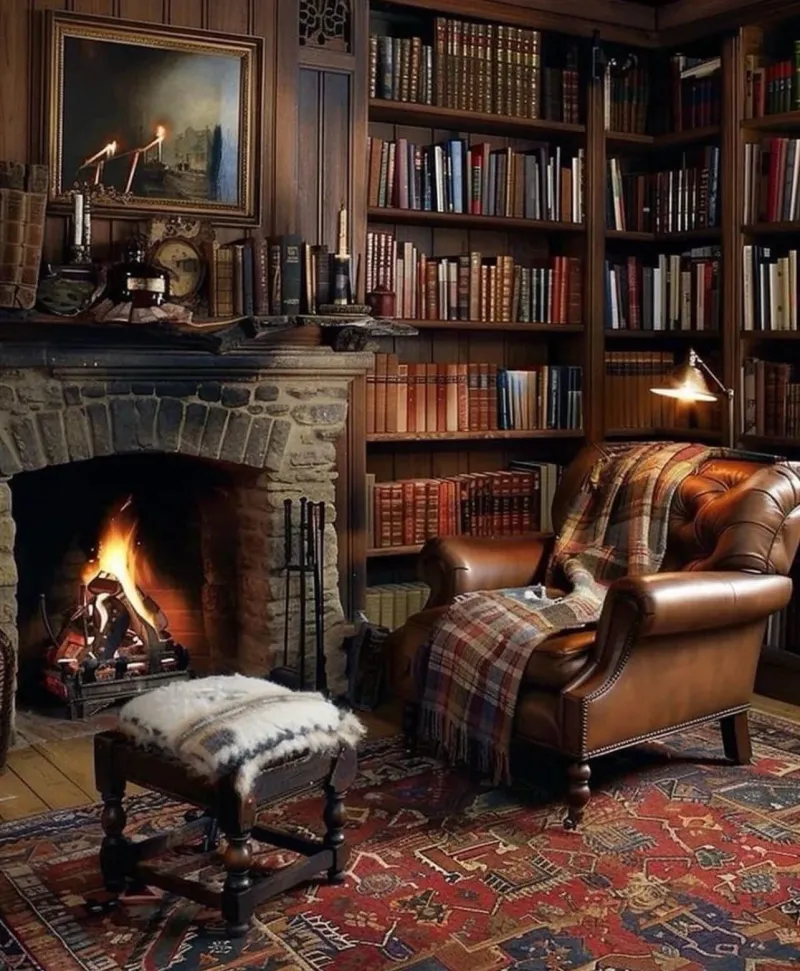
Photo: cosy inn reading room bookshelves fireplace armchair British countryside, via i.pinimg.com
You can tell a great deal about an inn from its bookshelves. Not the decorative kind — the ones dressed by a stylist who picked volumes by colour and spine width — but the real ones. The shelves where the books have been read, where some of the spines are cracked and the pages have gone slightly wavy from a damp winter, where there's a handwritten note tucked inside one of them that nobody has ever removed.
Withland has those shelves. Several of them, in several inns, each one as distinctive as the person who assembled it.
The Collection as Self-Portrait
A personal book collection is, among other things, a kind of autobiography. It records what someone has been interested in, what they've returned to, what they couldn't bring themselves to throw away even when the shelf was full. When an innkeeper builds a collection for their guests, they're doing something more deliberate — they're making an argument about what kind of place this is and what kind of experience they're offering.
The distinction between a curated inn library and a decorative one is immediately apparent to any reader. The former has gaps, idiosyncrasies, the occasional baffling choice that turns out, on closer inspection, to be completely logical. It has local history sitting next to modern fiction sitting next to a dog-eared field guide. It rewards browsing in the way that a good second-hand bookshop rewards browsing — with unexpected discoveries and the sense that you're inside someone's genuine enthusiasms.
Across Withland, a handful of innkeepers have developed collections that have become, quietly and without any particular intention, part of what draws guests back.
The Local History Shelf
Almost every serious inn library in Withland has its local history section, but the quality and character of these varies enormously. At its most perfunctory, it's a row of county guides and walking maps. At its most compelling, it's a genuine archive: out-of-print parish histories, old agricultural surveys, slim volumes published by local societies in the 1970s that have never been digitised and can't be found anywhere else.
Innkeepers who have lived in the area for a long time often become unofficial custodians of this kind of material — not by design, but because they're the sort of people who pick things up at estate sales and car boot fairs, who accept donations from regulars clearing out their parents' houses, who can't walk past a charity shop without checking the history section.
The effect on guests is notable. People who arrive with a vague sense that they're somewhere historically interesting leave with a much more specific, grounded understanding of the landscape around them. A walk that was pleasant before becomes resonant after an evening spent reading about the enclosures, the old droving routes, the families who farmed this land for centuries. The books change the way guests see the countryside, and the countryside changes the way they read the books.
Fiction With a Sense of Place
The fiction shelves in Withland's inn libraries tend to be more eclectic, but the best of them share a bias toward books that are rooted in place — novels where the landscape is not backdrop but character, where the rhythms of rural or small-town life are rendered with genuine attention. You'll find a lot of Thomas Hardy. A surprising amount of John Cowper Powys. Patrick Leigh Fermor, obviously — the innkeeper's travel writer of choice across most of Britain.
What's interesting is how these collections shape what guests read during their stay. People who would never normally pick up a novel about the English countryside find themselves drawn in, partly because the physical context makes the subject matter feel immediate. Reading about the Dorset hills while sitting in a Withland inn with rain on the windows is a different experience from reading the same book on the Tube.
Several innkeepers have noticed that guests begin conversations about books they've found on the shelves — often with other guests, sometimes with the innkeeper themselves. These conversations can go on for a long time. They tend to end up being about something larger than the book: about place, about what we're looking for when we travel, about what it means to slow down long enough to actually read something.
The Treasured Volume
Every serious inn library has its centrepiece — the book the innkeeper would rescue in a fire, the one they recommend before any other, the one that has been read so many times it has to be handled carefully.
These volumes are often surprising. Not the obvious choices, not the books you'd expect to find in a country inn, but something more personal and specific. A privately published memoir by a former local gamekeeper. A 1930s guide to British wildflowers with handwritten annotations throughout. A collection of letters between two long-dead correspondents who happened to have lived three miles from where the inn now stands.
When innkeepers talk about these books, they talk about them the way people talk about objects that carry meaning beyond their physical form. They're not just books. They're connections — to the place, to the past, to the particular quality of attention that makes someone a reader in the first place.
Reading as Part of the Stay
The broader cultural shift toward slow travel has been good for inn libraries. Guests who arrive specifically to do less — to walk, eat, sit, and think rather than to pack in activities — tend to read more. The inn library, for this kind of traveller, is not a nice-to-have but a genuine resource.
Some Withland innkeepers have responded by making their libraries more deliberately central to the experience: comfortable chairs arranged near the shelves, good reading lamps, a small table for a glass of something. The implicit message is that this is a place where reading is not just permitted but encouraged — where the afternoon is yours, the fire is lit, and there's a book on the shelf that you haven't found yet.
That book, when you find it, will feel like it was put there for you. It wasn't, of course — it was put there by someone who loves books and loves this place, and hoped that the two might, in time, find each other.
In Withland, they usually do.